LangChain Prompt Chains: Treat Prompts as Maintainable Programs

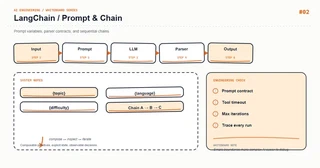
Whiteboard: LangChain — LangChain Prompt Chains.
A prompt is not an untracked block of text buried in code. It is a program component that needs versioning, input validation, and regression tests. This article builds a reliable template, structured input, model, and parser flow.
Core mental model
A stable Prompt Chain separates system rules, the human task, and conversation context. Variable names should carry semantics; avoid letting a generic text value change meaning across stages.
Key mechanics
Render and inspect the prompt before calling the model. Budget long context and delimit user text; never concatenate user-controlled content into system instructions.
Python example
from langchain_core.prompts import ChatPromptTemplate
from langchain_core.output_parsers import StrOutputParser

prompt = ChatPromptTemplate.from_messages([
    ("system", "Answer only from context; say when it is insufficient."),
    ("human", "<context>\n{context}\n</context>\nQuestion: {question}"),
])
chain = prompt | model | StrOutputParser()
print(chain.invoke({"context": "An idempotent request does not create extra side effects when repeated.", "question": "What problem does idempotency solve?"}))
Course focus
This article turns the whiteboard into explicit engineering boundaries: define inputs and outputs first, then decide how state, failures, and observability work. The examples use Python and focus on durable design principles rather than a particular provider version; verify APIs against the documentation for your installed dependencies.
Engineering practice
- Keep business rules in the application layer instead of hiding them in untestable prompts or route handlers.
- Add timeouts, bounded retries, and idempotency keys to external calls; retries are not a complete error strategy.
- Record a request id, latency, input version, model/index version, and outcome without logging sensitive raw content.
- Use a small fixed regression set first, then monitor quality and cost with sampled production traffic.
Common mistakes
- Drawing only the happy path and omitting timeouts, empty results, rate limits, and rollback paths.
- Letting one function parse input, call providers, build prompts, and persist data.
- Replacing typed contracts with string conventions that can only be verified by manual integration.
Production checklist
- Inputs, outputs, and error responses have explicit schemas
- External dependencies have timeouts, bounded retries, rate limits, and fallbacks
- Logs, metrics, and traces can be correlated to one request
- Critical paths have unit tests, integration tests, and offline evaluation samples
- Secrets, user content, and provider responses follow least-privilege and privacy rules
Practice
Implement the smallest loop shown on the whiteboard. Inject a timeout, an empty result, and a malformed payload, then check whether the system remains stable and diagnosable. Add one metric that proves your optimization improved quality or latency.
Hands-on exercise
Add a prompt_version, keep 20 fixed questions as a regression set, and compare factuality, abstention rate, and token usage before and after each prompt change.
Conclusion
An AI feature becomes maintainable when every arrow on the whiteboard maps to an input, an output, and a failure strategy.
